
The best software disappears.
You reach for it when you need it, and then you stop thinking about it. That's the whole of the feeling, and it's surprisingly rare. Most software today — apps, dashboards, mobile keyboards, browser extensions — operates on the opposite principle. It insists on being noticed.
The default is noisy
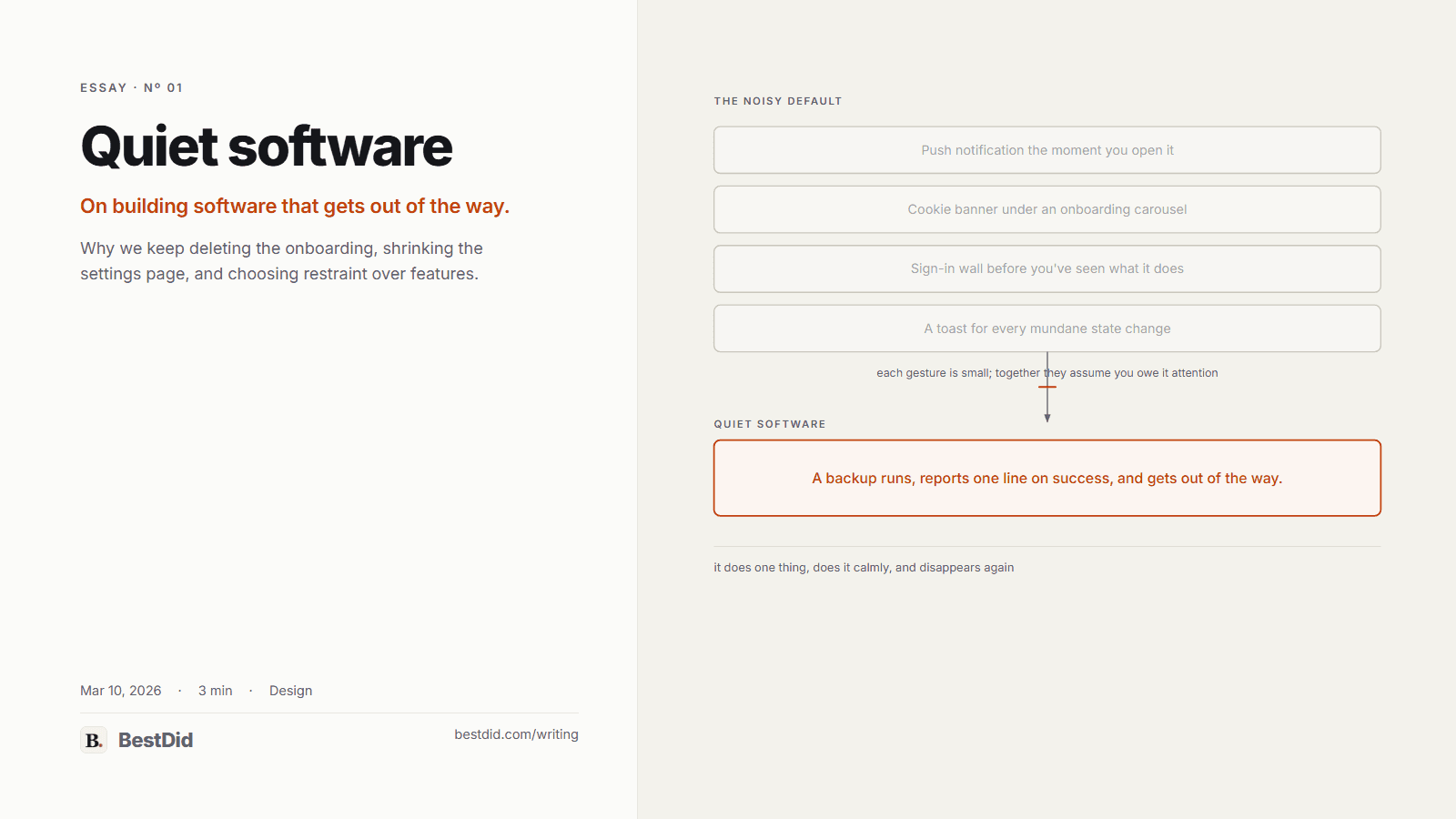
Push notifications the moment you open an app. Cookie banners layered under onboarding carousels layered under modals. A sign-in wall before you've had a chance to see what the thing does. A toast at the top of the screen for every mundane state change.
Each of these gestures is small. Together they form a pattern: the software assumes you owe it attention.
Quiet software is the inverse
It does one thing, does it calmly, and disappears again. A backup that runs, reports a single line on success, and gets out of the way. A security firewall that hides its dashboard until something needs your attention. A mobile expense tracker that opens directly to the screen you came for.

It takes longer to build
Quiet software means deleting. You cut the onboarding carousel after you've already built it. You shrink the settings page. You don't add the celebratory toast because the state change is self-evident. You replace a nine-step flow with three, then test whether two is enough.
It's also less marketable. You can't put "now with AI" on a product defined by what it refuses to do — though as we've written elsewhere, restraint is the stance we bring to AI features too.
Why we keep building this way
The reward comes later. Software that doesn't demand attention tends to get kept. It gets used on the second Tuesday of the month, and the third, and the fourth, because it's not costing anything to have around. That compounds.
We don't always succeed at this. But it's the direction we're pointing.